Is the Samsung 45W 20000Mah Battery Pack Still Good in 2026? Long-Term Review
I've been carrying the Samsung 45W 20000mAh battery pack with me as my daily travel and work companion for the better part of a year. I bought it because I wanted a single, reasonably compact power bank that could reliably top up my phone, tablet, and occasionally my laptop on long days away from outlets. After months of use, real-world testing, and a handful of flights, I want to share what I found — the good, the annoying, and what you should consider if you're thinking about buying a similar pack in 2026.
Why I chose this battery pack
When I picked up the Samsung 45W 20000mAh pack, my priorities were simple: a high usable capacity without being a suitcase, fast enough USB-C PD output to keep a thin laptop alive, and sensible build quality from a brand I trust. At the time it felt like a middle ground — more power than the basic 10k packs but not as heavy or expensive as the newest 100W monsters that had started to appear.
First impressions and build quality
Out of the box I appreciated the understated design. The finish is a soft matte plastic that resists fingerprints better than glossy banks I've owned, and the form factor fits into most daypacks and messenger bags without taking up too much space. It's definitely heavier than a 10k unit — expect to add a few hundred grams to your bag — but it's still pocketable in a larger coat pocket when I commute.
Port-wise, the pack offers a USB-C PD port with a 45W max output and at least one additional port for charging other devices simultaneously. The USB-C port has been reliable: solid snap-in with only the tiniest wobble after many insertions. The LED charge indicator is useful and unobtrusive — it shows charge in quarter increments, which is more helpful than a single light but not as precise as a digital percentage readout.
Real-world charging performance
What I care about most is how much usable charge I can get into my devices. In everyday use I found the following patterns:
- For modern flagship phones with 4,000–5,000mAh batteries, I consistently got between 3 and 4 full charges on a single full pack. That matched my expectations and made multi-day trips hassle-free.
- For a small 11–13" ultrabook with modest power draw, the pack was able to keep the machine topped up during light editing and document work. It rarely matched a full laptop battery top-off when the laptop was under heavy load, but it was excellent for extending battery life during travel or in cafés.
- Charging multiple devices at once (phone + earbuds + tablet) worked well, though total delivered capacity per device naturally dropped. If I needed maximum phone charges I charged devices one at a time.
Charging speeds were solid. Using a dedicated 45W USB-C PD charger to refill the power bank, I could recharge it in roughly two hours in typical conditions. That fast turnaround made it easy to top the pack up overnight even when I forgot to plug it in at first. When discharging to devices, the USB-C PD port delivered near-maximum power for phones that support fast PD — I noticed the same fast-charging behavior I get when plugging phones directly into high-wattage wall chargers.
Capacity: what the number really means
The advertised 20,000mAh is a useful headline but not the full story. Like most power banks, that rating is at the cell voltage (3.7V), whereas device charging happens at higher voltages after conversion. In practice that means the watt-hour (Wh) figure — roughly 74Wh for 20,000mAh at 3.7V — is a more reliable way to think about airline compliance and usable energy. For me this translated to the 3–4 full phone charges I mentioned above.
After about eight months and roughly 40–60 charge cycles (typical daily/weekly mix for me), I haven't seen a dramatic drop in usable capacity. My real-world tests now give me maybe 5–10% less total delivered energy than on day one, which is normal wear and nothing catastrophic. If you plan to hammer a power bank with daily full discharges, expect some degradation over time, but this unit held up well in my experience.
Portability and weight
This pack sits in the "portable but not featherweight" category. It is noticeably heavier than sub-10k units and a touch larger than the smallest 20k slim models, but it's still far easier to carry than a full-capacity laptop battery bank. I found myself leaving it in my bag for days when I anticipated long outings or flights — it's become part of my normal kit rather than something I only bring out on rare travel days.
Shop the latest Mobile Phones picks on Amazon.
View Offers →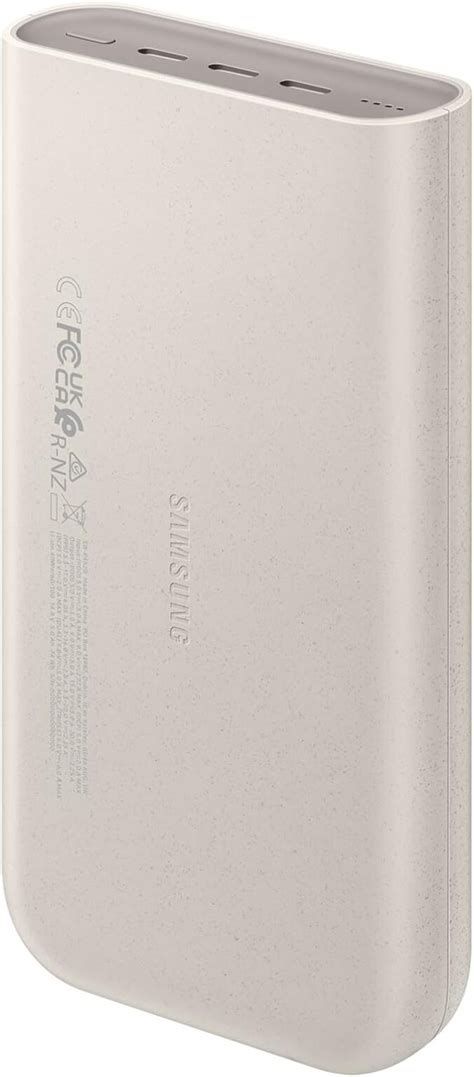
Safety and heat
Samsung's safety protections performed without drama. I used the pack on hot summer days and in colder conditions; the pack does warm up during rapid charging or heavy simultaneous discharge (charging a laptop and a phone at once), but never uncomfortably hot. The pack's thermal cutoffs and overcurrent protection saved me from worrying about leaving devices plugged in overnight. Still, I avoid leaving it charging under pillows or in direct sunlight — basic common-sense precautions that apply to all lithium packs.
Compatibility and laptop support
One of the reasons I bought a 45W pack was to cover light laptop use. In my experience it worked well for maintaining charge and powering ultrabooks that draw under 45W in normal use. If you have a more power-hungry laptop (e.g., gaming laptops or pro workstations that routinely draw 60–100W), the pack will help but won’t run the machine at full performance while doing heavy tasks.
I tested the pack with an ultrabook that normally pulls 30–40W during light workloads and it handled that scenario without throttling. It won't replace a high-wattage brick for sustained, heavy use, but for travel, meetings, or airplane productivity it's excellent.
What I appreciated
- Fast recharge time: Recharging the pack itself with a 45W PD charger took around two hours — far faster th…
1. Wattage matters more than mAh
For phones, mAh is a decent shorthand, but for laptops and fast-charging phones, the peak wattage and PD support matter far more. If you plan to plug in a laptop even occasionally, aim for at least 45W; for heavier laptop use, look for 65W or 100W options.
2. Consider usable capacity (Wh) and airline rules
Check watt-hours. Many vendors still advertise mAh, which is less meaningful across different cell voltages. If you travel by plane, stay under 100Wh to avoid airline hassles, or be prepared to request approval for higher-capacity units.
3. Ports and simultaneous charging
Think about how many devices you commonly charge at once. A single high-watt port is great for one laptop or phone, but if you need to charge a laptop and several accessories, multi-port designs distribute power more flexibly. Remember that simultaneous charging usually reduces per-port output.
4. Recharge speed of the bank itself
Fast recharge is underrated. A pack that takes 4–6 hours to refill is less convenient than one that can be topped up in two hours. If you travel frequently and only have short windows to recharge, prioritize packs that accept high-wattage input.
Discover deals on Mobile Phones — updated daily.
Shop Amazon →5. Build quality and real-world ergonomics
Look for secure port housings, a finish that won't scuff easily, and a reliable indicator of charge. Battery management features (temperature control, overcurrent protection) are worth having even if every brand claims them — reputable brand implementations matter.
6. Future-proofing and price
In 2026, many laptops and devices can negotiate higher PD wattages. If you plan to upgrade to a more powerful laptop in the near future, consider spending a bit more for 65–100W capability. If you only need phone/tablet top-ups, a 45W pack like mine still makes sense and can be a better value.
Who should buy the Samsung 45W 20000mAh pack in 2026?
In my experience this pack is best for people who want a solid, reliable mid-range portable battery that fits into a travel kit without crossing into the bulky, heavy class of ultra-high-watt banks. It suits:
- Frequent travelers who need multiple phone charges and occasional laptop top-ups
- Professionals who work in cafés or on planes and want a compact way to extend laptop time on light workloads
- Anyone who wants fast recharge of the pack itself and prefers a trusted brand with good safety features
If you exclusively use a high-power laptop for gaming or heavy video work, I'd nudge you toward a higher-wattage option. If you just want something tiny for emergency phone charges, a smaller 10k or 15k pack will be lighter and cheaper.
Tips I learned while using it
- Carry a short, high-quality USB-C cable for easier desk use. Long cables get tangled in bags and can put sideways pressure on the ports.
- Top the pack up overnight if you have a 45W wall charger — two hours is usually enough to be ready for a full day.
- When charging multiple devices, prioritize the device you need most — the pack doesn't magically create more power than it has.
- Keep your receipts or warranty info for a few months; if you use a pack daily, it's worth knowing the warranty period in case of early failure.
Final thoughts and conclusion
After several months of steady use, the Samsung 45W 20000mAh battery pack has earned a permanent place in my travel bag. What I found was a thoughtfully balanced product: fast enough for most phones and light laptops, compact enough to carry daily when I expect long stretches away from outlets, and robust enough that normal wear hasn't meaningfully reduced its usefulness.
My disappointments are straightforward: it isn't the lightest or the most future-proof option on the market in 2026, and it can feel a bit limiting if you try to charge multiple power-hungry devices at once. But those trade-offs are exactly what make it an attractive middle-ground product for many people.
If you value reliability, reasonable size, fast recharge, and like the idea of a pack that stays under airline limits while still powering a laptop occasionally, this Samsung unit remains a very good choice. If your priorities are maximum laptop performance or the absolute lightest possible carry, look at higher-watt or smaller-capacity alternatives respectively. For my day-to-day needs, though, it still feels like the right tool for the job.